


Proprietary Dough Manufacturing at Scale
How to Manufacture Your Signature Dough at Scale (Without Losing Consistency)
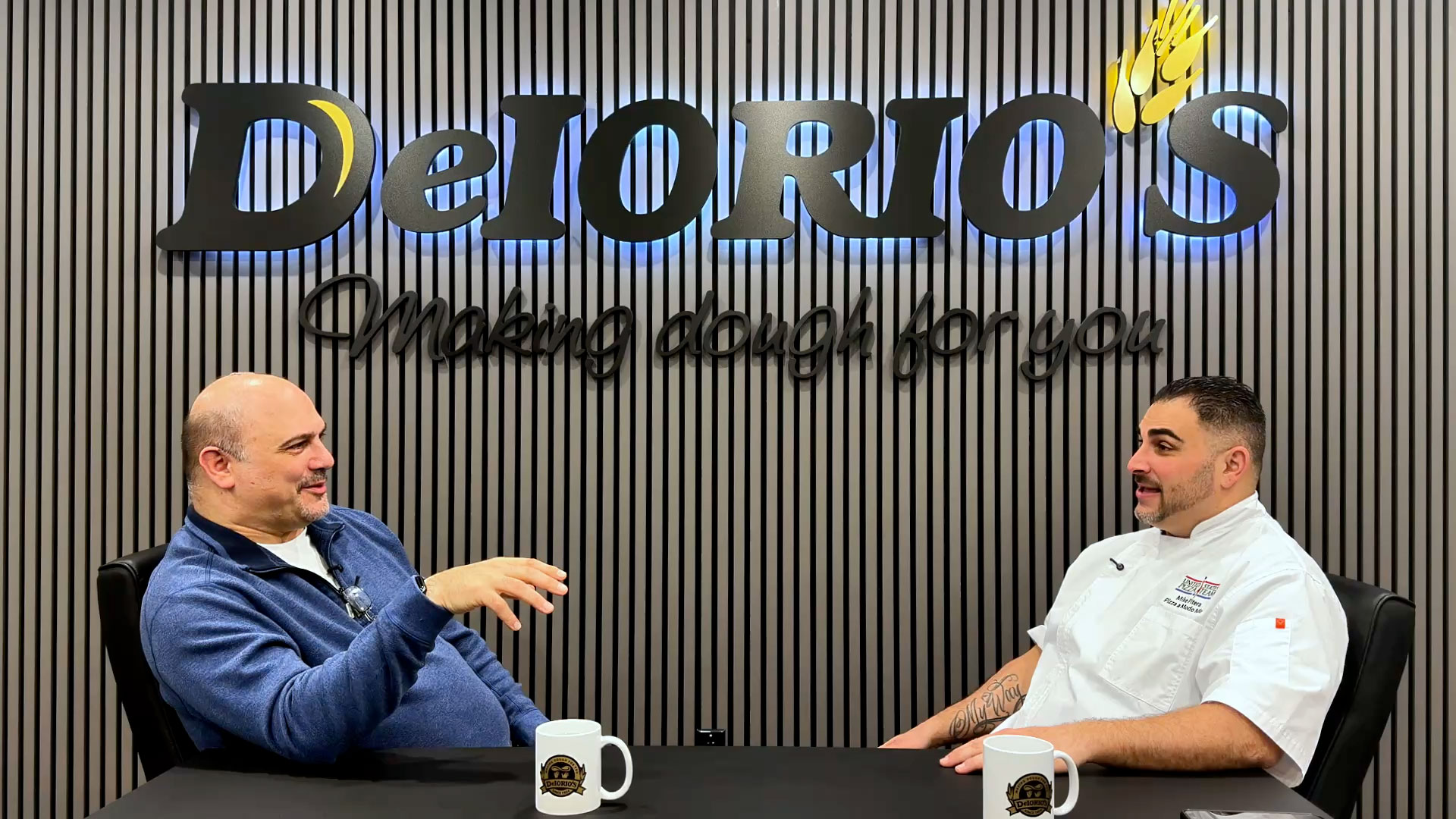
A candid DeIorio’s podcast conversation with Jim + Mike on why multi-unit brands move to custom-formulated, fresh-to-frozen dough: consistency, training simplicity, and repeatable performance across locations.
Related: Your Signature Dough at Scale | Who We Serve | Pizza Dough Guide
If you’re running 5, 50, or 500 locations, dough stops being a “recipe” and becomes an operational risk. One store overproofs. One manager changes hydration. One new hire “eyeballs” salt. Suddenly your “signature crust” isn’t signature anymore—your brand is inconsistent.
In this episode, Jim and Mike unpack what breaks when you scale: why scratch workflows drift, how labor realities force simplification, and why custom formulation becomes the lever that keeps taste + texture identical at every location—without turning your back office into a bakery.
Key Takeaways
- Scratch doesn’t fail because it’s “bad.” It fails because it’s hard to reproduce across stores, climates, and skill levels.
- Frozen dough isn’t the compromise people assume—when engineered correctly, it becomes a consistency engine for multi-unit growth.
- Custom formulation is the bridge between “using a supplier” and owning a signature product at scale.
- The win is operational: fewer failure points, faster training, predictable output.
Consult with a Dough Specialist
If you’re protecting a signature crust while expanding locations (or launching a branded dough program), the next step is a short spec conversation.
- Multi-unit pizzerias (5+ locations scaling to 20/50/100)
- Institutional programs (schools, campuses, c-stores)
- Distributors & private label brands (formula manufactured under your packaging)
The Scaling Problem Nobody Admits
When you’re small, scratch dough is manageable because the same few hands touch everything. When you scale, you inherit constraints:
- Different store conditions (humidity, temperature, cooler performance)
- Different staff skill levels (and turnover)
- Different interpretation of the “same” recipe
- Different timing discipline (proofing windows, fermentation cycles)
That’s how chains slowly lose what made them famous: customers can’t describe it, but they feel it—“this location isn’t as good.”
Product Programs Built for Scale
DeIorio’s product formats are designed to match different operational constraints—labor, speed, storage, and consistency. Explore the core programs:
- Dough Balls (traditional workflow, closest to scratch)
- Dough Flats, Shells & Self-Rise (pre-shaped convenience + faster handling)
- Par-Baked Shells (no proofing—top, bake, serve)
- Gluten-Free (par-baked + frozen for quick prep and longer shelf life)
Custom Formulation: Keep the Signature, Remove the Chaos
This is the core theme for larger buyers: you can keep your signature dough identity without running full scratch operations at every location.
Custom formulation means:
- You define what “your dough” is (taste, bite, browning, extensibility, bake performance).
- DeIorio’s works with you to tweak and lock in the spec.
- Once approved, it’s manufactured with controlled production so each batch performs the same.
How Custom Formulation Works (Simple 3-Step Flow)
- Spec Definition — Align on performance (style, bake method, handling, finished bite).
- Pilot & Validation — Test, refine, confirm performance in real operating conditions.
- Scale Production — Manufacture-to-spec so every location gets the same result.
Proof Matters: What “Manufacturing at Scale” Should Mean
When enterprise buyers evaluate a manufacturing partner, they focus on:
- Performance consistency — handling and bake results, batch to batch.
- Supply reliability — predictable replenishment across locations and seasons.
- Brand protection — fewer quality swings that create complaints and churn.
Bottom line: Consistency reduces operational noise so leadership can focus on growth, training, throughput, and marketing—not dough troubleshooting.
How DeIorio’s Helps Brands Scale (Operator + Enterprise View)
| Scaling Constraint | What Breaks | DeIorio’s Fix | Outcome |
|---|---|---|---|
| Consistency across locations | Different staff + conditions = different crust | Custom spec + controlled manufacturing | Signature taste everywhere |
| Training + turnover | New hires miss proofing/handling windows | Simplified workflows by format (balls / shells / par-baked) | Faster onboarding, fewer mistakes |
| Labor and waste | Bad batches, rework, inconsistent output | Predictable dough behavior + reduced failure points | Lower waste, steadier margins |
| Menu expansion | More SKUs = more complexity | Program fit by market: Who We Serve | More sales with less chaos |
| Distribution / private label | Need supply + spec control + brand ownership | Private Label / Signature Dough at Scale | Brand-ready product at volume |
Who This Podcast Is For
- Multi-unit pizzerias (5+ locations scaling to 20/50/100)
- Institutional programs (schools, campuses, c-stores)
- C-stores / foodservice chains
- Distributors & private label brands manufacturing under your packaging
FAQ
Can DeIorio’s manufacture my proprietary dough recipe?
Yes—DeIorio’s can work from your existing formula or collaborate to define a target spec (texture, flavor, bake performance) and manufacture it consistently at scale. Learn more: Private Label / Signature Dough at Scale.
What’s the difference between private label and custom formulation?
Private label is branding/packaging under your label. Custom formulation is creating or modifying the dough specification so the product itself becomes unique to your brand. Many enterprise programs use both.
Why do multi-unit operators move away from scratch dough?
Scratch introduces variability across stores, staff skill levels, and environmental conditions. Multi-unit brands prioritize repeatability—consistent crust quality becomes part of brand protection.
Which product format is right for my operation?
Start with DeIorio’s Pizza Dough Guide, then explore: Dough Balls, Flats/Shells/Self-Rise, Par-Baked Shells, Gluten-Free.
What information should I bring to a dough formulation consult?
Bring target pizza style(s), bake method (deck/conveyor), dough weight/size targets, desired crust characteristics, current formula (if available), and operational constraints (storage, proofing time, labor).
Next Step
Consult with a Dough Specialist to discuss your spec, your operational constraints, and what “signature dough at scale” looks like for your brand. Fill out the form below.